
I recently had the dubious pleasure of passing through the gauntlet of AWS exams and emerging certified in all 12 AWS certifications (plus some other retired ones).1 I am fortunate enough to have passed them all on the first take, though the Networking Specialty was a close call.
While the Internet may offer you an abundance of material on the subject matter of these exams, I do hope to provide some thoughts and reflections from my own experience on the why and how of these exams. Hopefully they may guide your path as you embark on this struggle with the AWS certifications process.
Jump to a question of interest to you, and I hope it proves helpful. Good luck.
Why are you taking an AWS exam?
This is not as intuitive a question as you may think.
You must weigh the cost of these exams, both financial and time-wise.
Unless your employer can bankroll the exam process, you must weigh the fiscal cost of the exam(s) you are planning to take. Even if someone else is paying for your exam fee, that should not on its tell you it is “free”.
You must still invest time.
Not just any time where you can be distracted or “second screen” your exam, but that valuable quotient of highly-focused and highly-energized mental state that can be hard to come by.
If you are cognitively drained or worn out, you simply will not be able to prepare for or take the exams, even if you are building on AWS every day.
Furthermore, if you do pass the exam, each individual AWS certification will only last you three years.
In most cases, you will need to sit the exam again and pay the exact same fee in three years time, just to hold on to the title. This is the AWS version of Continuing Education Credits.
Are you okay with that shelf life?
Now let’s think about why you may want to take the exam.
There are at least five distinct, general reasons I would like to mention.
1. Career Launch
This is in my view the most justified reason to take the AWS exams.
If you are needing some form of resume “rebrand” to initiate a career transition into technology, the AWS certifications can aid you in a career shift. It did for me.
I was a humanities major with a few years of professional experience in nonprofit operations. I had taught myself a few programming languages in this time.
But the critical push that enabled my true technology career launch was having freshly minted AWS certifications to decorate my resume and online profiles.
It started with small freelancing projects and escalated from there.
However, to repeat commonly iterated advice, certifications do not get you the job on their own, but they can help you get the interview. And that is sometimes the hardest barrier.
So one should not expect to be handed a job or comfortable contract upon earning their AWS laurels, but it can smooth your entry path.
2. Career Advancement
Let’s say you have landed, so to speak, in your desired career track that can afford you progression to your professional north star.
There can be an impression that AWS certifications can provide you the opportunity for a promotion or generally vertical move.
From my point of view, I do not think this is true.
I say this from two vantage points.
First, in my experience from dozens of interviews for client projects as well as job roles, it is rare for the initial screener, the second round, or the round table to ask about certifications.
The only occasions it has come up is when third-party recruiters remark a specific certification is on the job description and you “matched” in their ATS scanner. But that is about it for me, anecdotally speaking.
Even then it has been mentioned to me that “cert collectors” look suspicious for hiring managers.
There can be a certain stigma around the certs that those who get them are the “all talk” folks who like to seem busy but do not actually build anything.
Second, I have had a number of conversations with various HR and hiring reps who work in the industry, and none of them mention certifications as a decisive factor.
Experience, societies & publications, and even degrees play a far greater role on that front to getting you somewhere vertically. At least from what I can tell.
So if you are already “in” technology, it is in many cases far more strategic to invest in resume-building projects or society memberships than AWS or other cloud certifications.
3. Learn AWS Better
One might want to leverage the AWS certification process as a way to learn AWS better.
This is probably the least efficient justification for taking an AWS exam.
You are far better off exploring the plethora of AWS-provided workshops and resources or the equally bountiful array of challenges and puzzles published by individuals or communities. For free.
The AWS documentation even offer example use cases for just about every facet of the platform. And you can evolve off their “hello world” scenarios with ease.
4. APN or Sales Benefits
The Amazon Partner Network (APN) offers special tiers and branding for those partners who have more certified individuals. An internal incentive to push the certifications program.
If acquiring an AWS certification advances your sales machine, that is fine. As long as you understand the inputs you are providing to make that happen.
I frankly am not one hundred percent sure, how much of an advantage it plays even then. But I have also not found much success on APN since they recently rebranded it, so I am the wrong person to ask about this.
5. For the challenge
This was my primary reason for this most recent gauntlet.
A while back, I picked up around 5-7 AWS certifications. I floated with those for a while and let them lapse when things got busy.
But after I concluded my previous role and I was on the lookout for something sufficiently productive and challenging for my time, I decided upon pursuing all 12 AWS certifications.
This is truly a challenge, but a great discipline builder.
Knowing that you are investing dozens of hours in preparation for a somewhat arbitrary exam that is not connected to hands-on experience. Preparation that drains your mind and inhibits your ability to be productive on other things. (I say that to dissuade others from following this course.)
Exams that cost money, even if potentially tax-deductible for the business owner.
I will be honest and say that I do not plan to renew these certifications outside the Professional level unless the incentive structure changes in some way.2
For myself at least. You may feel differently in considering your path.
Which AWS exams do you plan to take?
There are several considerations worth thinking through with this.
Like I mentioned above, HR and recruiters are very targeted about the certifications they are looking for, if any at all.
Certification collecting is the equivalent of putting buckets out in the rain to collect water when you could just turn on your tap water.
It is better to be focused and strategic about which AWS exams you choose. Even an individual one is fine. Or you could do targeted combinations like:
Solutions Architect Associate + Professional
AI Practitioner + Machine Learning Associate + Machine Learning Specialty
CloudOps Associate + Developer Associate + DevOps Professional
This can be advantageous for a couple reasons.
1. Renewals
When Professional Certifications renew, their Associate counterparts renew as well.
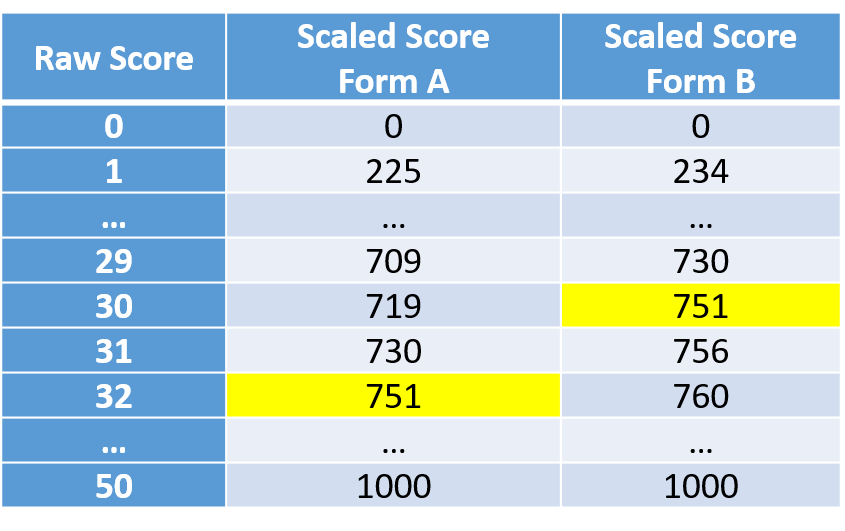
Unlike Azure certifications, AWS will make you pay up and take the whole exam to renew your certification.
However, if you stick with a particular bundle, like the ones listed above, you would only need to renew the one Professional-level to hold on to the Associate level.
2. Content Overlap
If you are taking particular exams in rapid succession, this is also useful.
While it occurs less frequently than you’d expect, closely coupled AWS exams will feature near-identical questions.
I took the Machine Learning Associate and Specialty back-to-back, and I was surprised by how much the two exams had in common. (More on that later.)
Because the exams are more-or-less focused on your ability to recall AWS best practices and patterns, this can reduce the amount you need to learn during preparation.
3. Certification Shelf Life
There is a running joke that Google likes to shut down products and services nearly as often as they start them.
AWS has in the past few years seemed to adopt this methodology for its certifications.
In 2022, I had taken and passed the AWS Database Specialty and AWS Data Analytics Specialty, both of which have since been decommissioned. The AWS SAP and AWS Alexa Specialty exams have also both been shut down since I first started exploring AWS certification.
It is mid-2025, and I am convinced that AWS Machine Learning Specialty will be put down soon as well.3
Some certifications are simply more forward-facing than others. In 2025, AI Practitioner is one of those. The SysOps Administrator is getting rebranded as CloudOps Administrator.
You can also tell in the exams themselves which one is newer. While the curators who review AWS certification questions do a remarkably good job making sure outmoded services or approaches do not makes unwanted appearances in exam questions, you can still tell the relative age of the exam based on its language and terms.
The Data Engineer Associate and Machine Learning Associate exams though at the Associate level have a far more up-to-date of AWS offerings and cloud strategy than their Specialty counterparts.
Pay attention to that when deciding which ones to take. If you like.
Venue: How do you plan to take the exam?
This is more important than it sounds.
At this time, you can take an AWS exam either from a Pearson VUE testing center or from the comfort of your home.
I am honestly on the fence which of these two is better.
The online option can be a hassle because the Pearson VUE proctors are radically stringent on protocol in extremely arbitrary ways.
If you take the exam from your workstation, you will have to dismantle much of your desk setup to clear it off, remove extra monitors, and make sure no “content” is visible from any angle in the room.
The first time I had taken the DevOps Professional exam, the proctor noticed a painting I on the back wall and demanded I take it down, even though it was nailed in. This was all the more surprising because I had taken three other AWS exams from that same room with the same art on the wall, and it had never come up before.
Beyond the initial screening, you are monitored rather closely. They will interrupt your exam and call you if you so much as have your hand over your mouth over the course of the two or three hour exam.
But most importantly, you are not allowed to leave the room whatsoever. Restroom breaks are not permitted whatsoever if you are doing the online proctoring option.
This becomes far more obtrusive during the three hour examinations (which include another thirty minutes for check-in), and I have had to rush to finish exams early because of this.
By contrast, the in-person test centers can vary rather dramatically. If you live in a metropolitan area you can see for yourself how much this can be the case. Some are in basements, while others have windows. Some have sound machines.
The proctors can have varying dispositions, ranging from conciliatory to neutral to DMV hostility.
The main factor for me are your neighbors in the shared exam room.
You will most likely be in a room with other exam takers sitting close beside you.
For whatever reason, these professional certification exams tend to attract individuals who make unusual noises or whisper to themselves during the exams. Perhaps I do so as well unknowingly.
There was one point I recall for the Machine Learning Specialty exam where I could not help glancing over at another test taker in the room because of how labored their breathing was, like a lung was punctured. Par for the course though.
On the flip side, you do get restroom breaks at these testing centers, and you far less at risk for having your exam disqualified for arbitrary reasons than if you take them from your residence.
So something to bear in mind.
Strategies
Now that we have taken into account a few preliminary questions, I would like to suggest a few strategies for preparing for and taking these AWS certifications.
Test Prep - AI Assistants
First I would like to say that Tutorials Dojo is by far the gold standard when it comes to AWS certification practice exams. They offer the most rigorous and realistic simulation of the AWS exam experience, to the point that I am surprised they are allowed to simulate such an accurate reflection of exam content.4
Beyond that though, I am deeply indebted to AI assistant tools for helping prepare me for the most difficult Specialty exams. That is the point at which I had started leveraging AI for studying.
If you supply the appropriate AI assistant with the exam content guide and give it a few sample questions, it does a profoundly excellent job of generating practice questions for you.
I have done this to help identify general preparedness, then to isolate areas of improvement, then to cover specific domains or services or service features I needed to brush up on.
However, this does come with a strong caveat. If you provide it with practice questions yourself, it has a moderate chance of hallucination.5 It is far better to ask it to find its own using web search than supplying any in-line.
If you are verifying the answers yourself and continuing to feed it documentation, you will find it is a strong partner to coach you question-by-question to prepare you on the knowledge required for the exam.
The Exams Play Favorites
With any professional certification, there is an ongoing debate over how much that certification really does equate to “real life experience”. In my eclectic experience across developer, DevOps, cybersecurity, and management roles, I will say the AWS certification exams really do very little to prepare you for the real world.
Part of this is because (like most exams), the real world gives you free access to the Internet, documentation, and now for the most part AI assistants.
But another part of this is because the multiple-choice structure of the exam lends itself to a fairly opinionated outlook on what constitutes the “right” answer. This can be a world of a difference depending on the exam you are taking.
The most overt example of this is the AWS Data Engineer Associate and AWS Machine Learning Associate exams.
In the AWS Data Engineer Associate Exam, the answer that names AWS Glue is nearly always the right answer. That service is the gold standard for that exam.
In the AWS Machine Learning Associate Exam, the answer that names a SageMaker tool is nearly always the right answer, especially if AWS Glue is an alternative choice. It is actually fairly tricky how some questions will make AWS Glue sound appealing in the ML exam, but only to trick you. The answer explanations on those practice exams explain why SageMaker “is a better fit”.
So get to know the community of your exam, because it actually does consist of a fairly opinionated set of tools. Even on the wide-ranging Solutions Architect Professional, there is a gamut of AWS service that will simply never be mentioned from virtue of being too obscure to be noteworthy.
The Types of Questions
Aside from subject domain, there are a number of different kinds of AWS questions. You can actually identify the answer to the question based off a few “meta” considerations, without knowing anything about the subject matter or content of the question.
You can categorize 90% of AWS questions as:
Do you know AWS basics?
There is a question about IAM and S3 in just about every exam.
Do you know the most AWS managed approach?
AWS wants vendor lock-in. Therefore your answer should also be the most conducive to vendor lock-in. The custom, roll-your-own solutions are almost always the wrong answer. Picking the most AWS-managed option is a very likely right answer, excepting a few edge cases.
Do you know which suggested approach aligns with the key priority for this question
Many of the intermediate to expert level difficulty questions will have a paragraph or two introducing the situation, but it always best to start with the one sentence closer at the end of the question. This will identify the key priority for the question:
“What is the MOST cost efficient approach?”
“What is the MOST operationally efficient approach?”
“What is the MOST secure option?”
It is absolutely critical to use this lens when scanning both the questions and answers. There are a handful of cases in exam questions, when a generally acceptable answer is actually incorrect because the question is looking for more very specific priority.
Do you know this technical domain independently of AWS
There are a handful of questions surrounding encryption or DNS or machine learning algorithms which you will immediately have an answer to if you have a theoretical or practical grasp of its underlying concepts.
Technical knowledge irrespective of AWS will give you a shortcut to the answer.
Have you lived through this very specific scenario. If so, when does the AWS UI show at step 3?
There are a small handful of edge case questions which you can tell are supposed to be the most difficult ones out there. Unless you have battlefield experience with that specific item they are asking about, you will not know the very specific thing they are asking for.
If you in fact have had that experience, you will feel rather clever for knowing the answer.
But these are a small proportion and you do not need all of these to pass the exam, unless you are struggling on basic or intermediate items.
Miscellaneous
A few other test-taking strategies I would like to note for the exam-taker
If the question is particularly long, it is worth starting by reading the answer choices. Sometimes the answer choices are also long and nearly identical, but this is a good thing. You can use to identify what makes each answer choice *different* from one another, and this makes it easier to eliminate the incorrect options.
If you are struggling with a question, it is generally best to try to eliminate the answer choices down to two options (or sets of options) then review the question and see either if (1) you can identify a key architectural concern like cost optimization or security or (2) if you can visualize the technical specific steps because there is often a trick that can eliminate the wrong answers.
Depending on your pace and time remaining, it is okay to skip questions without reading them and then return to them later. If I was two-thirds through an exam and encountered a three paragraph question, I would invariably flag it and come back at the very end when I knew I could focus on it. Not all questions are equal in difficulty and it may be worth sitting on the most difficult ones until there are no others remaining.
Remember that you do not need to get every question right, and also remember that roughly ten questions on your exam are not even scored. Be familiar with the estimated pass rate metrics for your exam so you have a comfortable sense of how many questions you can miss. Aiming for 100% accuracy will do more to obstruct your psychologically than to help you hit your goals. Think in terms of 80:20 Pareto optimization to be able to reach a threshold to pass the exam.
Sometimes the answer to one question may accidentally be revealed in another exam question, further down the line. This has happened to me more than once. If you realize during the exam, you have gaps, try to construct answers from the knowledge base provided to you in the exam questions.
Know your reading speed. The word counts on these exam are heavy, especially if you are on the Professional exams. That is honestly one of the largest contributors to the cognitive difficulty of the exam experience (and also why the Cloud Practitioner exam is a breath of fresh air by contrast). If you are a fast reader, that certainly works to your advantage. If English is not your first language, make sure to exercise the testing accommodation for extended time. Regardless, reading the end of the question and answers first before reading the bulk of the question can help save you some time and reading energy on each individual question.
Unless you are taking a Foundational exam, you will not be told your results immediately upon finishing the exam. So do not expect to find out right away. However, for all the exams I took this year, I got the results in about 12 hours or so, depending on if I took the exam online or in a practice center.
Conclusion
These words are offered up in the hopes that they may prove useful or advisory for those considering AWS certification exams or preparing for them.
My experience is my own, and I cannot pretend that you will have the same experience if you choose to go through a gauntlet of twelve, three, or even one individual exam.
I merely wish you the best of luck on your endeavor as you build your cloud career.
A screenshot of my AWS IQ profile. AWS IQ is a platform for third-party freelancers and agencies to connect on specific projects.
AWS IQ is an excellent venue to advertise services as an IC, and it does provide an ostentatious view of AWS certifications. Yet, see footnote 2.
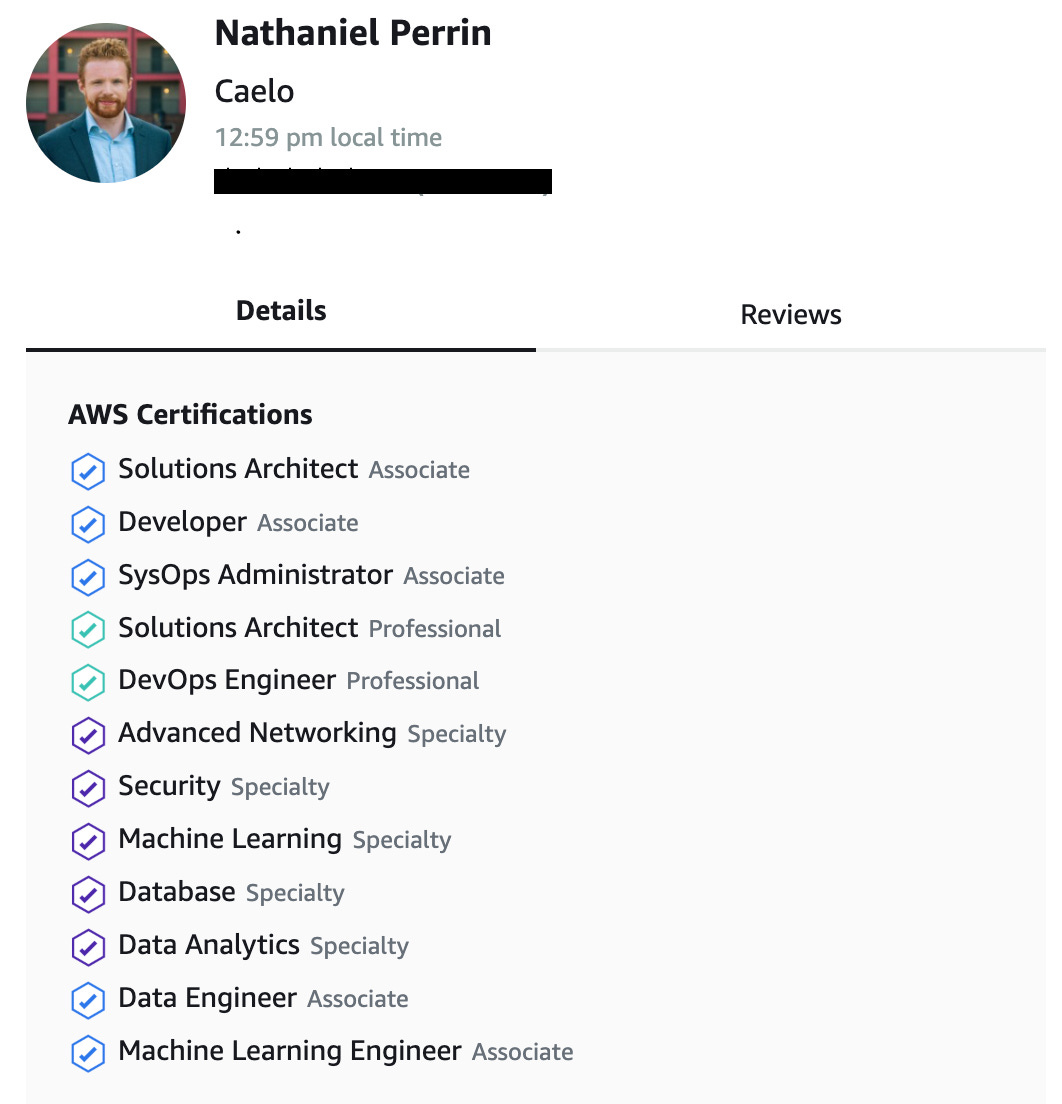
You will note the two Foundational exams do not display here, but this is made up for by the discontinued Database and Data Analytics Specialty exams which I had taken previously.
I was planning on expanding my consulting leads pipeline through AWS IQ—their official service for third-party experts. However, while I was in the midst of passing these exams, I discovered that AWS announced its intent to shut down the platform. So that motive was rendered nugatory.
EDIT from 2026, and sure enough it did - https://aws.amazon.com/blogs/training-and-certification/october-2025-new-offerings/
That said, in 2025, their practice exams are starting to show their age. I do not blame them for being unable to keep up with the AWS question machine, but you do notice the practice tests they have for older AWS exams are loaded with questions that no longer make sense or line up to the modern AWS experience.
There are tricky questions in the AWS exams, but for example I was surprised not only that `o3` failed to identify what envelope encryption is, but when I pulled the same question up today, `GPT 5`failed in the exact same way, selecting the answer which indicated the top level key should be encrypted.